

[ad_1]
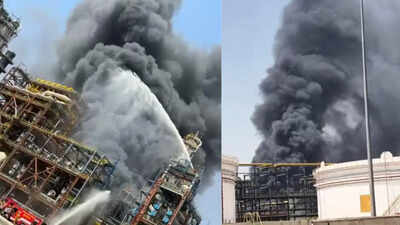
JAISALMER: Following the massive fire that broke out on Monday afternoon at the Pachpadra refinery in Balotra district, the Crude Distillation Unit (CDU) has been temporarily shut down. Repair work on the unit will begin only after investigations by multiple central and Rajasthan security agencies are completed. It is estimated that the CDU unit may take more than 3 to 4 months to be repaired and become operational again.Sources indicate that key components of the CDU were sourced from multiple countries, and procuring replacements could take considerable time. As a result, the refinery may take nearly a year to be fully ready again for inauguration.According to experts, the CDU unit was designed and engineered under the supervision of Engineers India Limited, while several heavy components such as large reactors and columns were manufactured at Larsen & Toubro’s Hazira plant in Gujarat. Some of the world’s heaviest equipment was transported to Pachpadra via sea routes and then moved on specially designed trailers with over 200 tyres.Additionally, high-pressure pumps and specialized valves used in the CDU were imported from Germany and other European countries. Technologies for petrochemical units were sourced from leading American companies like Lummus Technology and Honeywell. Heat exchangers and several other components were largely manufactured in India, with imported parts routed through Kandla and Mundra ports.Given the extent of damage, replacing burnt components and reinstalling new ones from overseas is expected to be a time-consuming process.The incident has also raised serious questions, including whether it was purely an accident or if there was any possibility of sabotage. The government has ordered a high-level inquiry. Experts suspect that the fire may have been caused by a hydrocarbon leak from a valve or flange in the heat exchanger circuit. The blaze remained confined to the heat exchanger stack, and timely isolation of the CDU, Vacuum Distillation Unit (VDU), and other sections prevented further damage.Industry experts emphasized that such incidents highlight the need for a highly professional, well-trained, and technologically equipped fire response wing capable of handling industrial emergencies of this scale—something that may not have been fully in place during the incident.Eyewitness accounts reveal that fire brigade sirens continued for nearly two hours, with around 40 fire tenders deployed. The refinery’s high-pressure firefighting system was activated immediately, spraying water from a height of about 50 feet. After intense efforts, the fire was brought under control.Experts cautioned against drawing premature conclusions, stating that key questions remain unanswered—such as which company supplied the unit, who was responsible for its operation, and whether proper technical audits had been conducted.They further noted that since the fire occurred in the “heart” of the refinery, the damage is significant. While major refinery components are usually double-insured and backed by global suppliers, the time required for replacement, fabrication, and reinstallation could result in substantial economic losses due to delayed production.The CDU–VDU units are the most critical parts of a refinery, where crude oil is processed into petrol, diesel, and other petroleum products. Damage assessment and repairs could take anywhere from one to six months. If commercial production had started as planned in July 2026, the refinery—with a capacity of 9 MMTPA—could have generated monthly revenues estimated between Rs 50,000 to Rs 80,000 crore. Each month of delay will now translate into significant revenue loss.According to a refinery engineer, crude oil supplied via pipelines first enters the CDU, where primary refining takes place. Residual crude is then processed in the VDU for further extraction before being sent to other units.Technologically, the Pachpadra refinery is considered among the most advanced in the world, with the CDU and VDU units accounting for approximately 8–12% of the total project cost.Meanwhile, CISF personnel stationed at the site played a crucial role in the initial response. Duty staff from QRT-1 first noticed the fire alarm near HRRL Gate No. 02 and observed smoke emerging from the CDU–VDU area—one of the key locations planned for the Prime Minister’s visit. The information was immediately relayed to the CISF control room at Gate No. 04, which alerted fire control authorities. CISF personnel and local police reached the site within minutes, secured the area, and ensured unobstructed access for firefighting and rescue teams, playing a vital role in controlling the blaze.
[ad_2]
Source link